
Geographic Patterns of Social Determinants of Health (GPS-Health)
Welcome to the GPS-Health project! We measure the geographic distribution of multi-level, multi-domain social and structural determinants of health in order to reduce and ultimately eliminate population health gaps for every community.
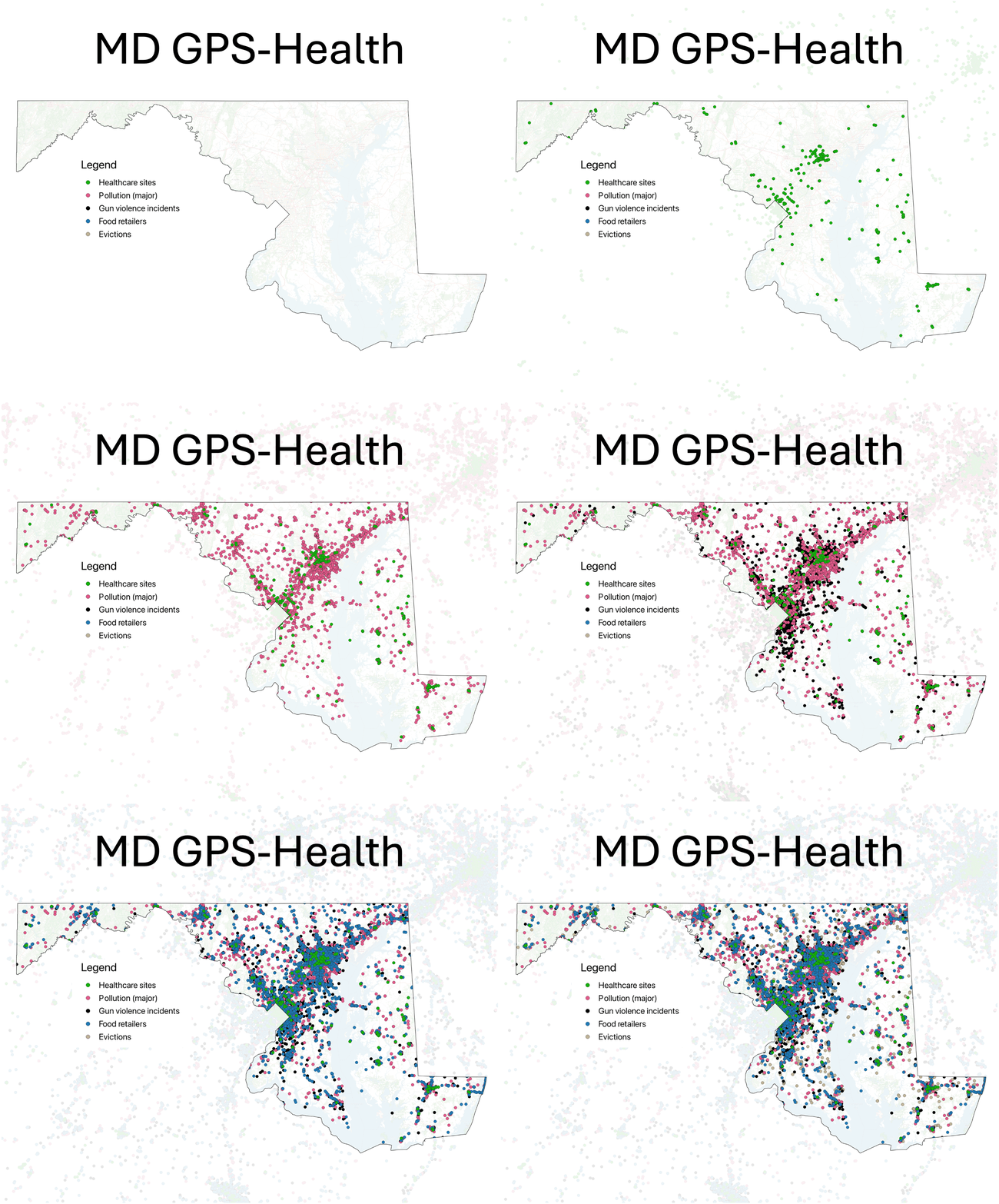
Everyday conditions of life impact up to 80% of our health outcomes. These everyday conditions include housing, transportation, safety, food access, our physical and social environments, and much more, and are collectively known as the social determinants of health. Resources and hazards for each of these conditions are systemically and unevenly distributed depending on where you live, driving large differences in health outcomes from diabetes, cancer, heart disease, infections, mental health, and longevity (to name just a few). How we structure our lives as a society bears directly on this distribution and consequently on the health of all.
Other current methods of measuring the geographic distribution of social determinants of health often either flatten multidimensional differences (e.g. low food access vs. exposure to pollution) that may require different solutions for better health, or aggregate to a geographic area (like counties or census tracts) that lack the precision needed for decision-making by communities, doctors, and policymakers.
Instead, GPS-Health uses social determinants of health as specific resources and hazards to which we can measure individual exposures. As a result, GPS-Health can preserve multidimensionality and employ individual address-level precision that can then be used with recent advances in computing methods as well as health data for both precision medicine and population health.
GPS-Health uses a framework to identify domains of social determinants of health resources and hazards. We then leverage publicly facing datasets that include exact geocoordinate locations to map these resources and hazards in relation to all Maryland addresses. While our methodology can be applied in any state, we are piloting GPS-Health with data from Maryland.
GPS-Health is still in the pilot stage. We currently have projects to measure the role of food deserts on diabetes outcomes, the distribution of resources and hazards in rural areas, and the role of healthcare sites on hypertension, as well as collaborative projects across the UM-IHC on other chronic disease outcomes. Several of these projects leverage the UM-IHC’s UMMS data.
- Huang, S. J., Davis, E. M., Nguyen, T. T., Brooks, J. R., Abaku, O., Chun, S. W., … & McCoy, R. G. (2025). GPS-Health: A Novel Analytic Infrastructure for Capturing, Visualizing, and Analyzing Multi-Level, Multi-Domain Geographically Distributed Social Determinants of Health. medRxiv, 2025-01.https://doi.org/10.1101/2025.01.03.25319962
Building GPS-Health requires a large, interdisciplinary team from across the UM-IHC made up of clinicians, population and public health scientists, social scientists, statisticians, computer scientists, data scientists, software engineers, geographers, and students.
Conceptualization: Shuo Jim Huang, Rozalina G. McCoy
Computing and statistical methods: Chixiang Chen, Seyedmohammad Shams, Thu T. Nguyen, Justin R. Brooks, Anup Mahurkar, Sai Yerramreddy, Sinan Aktay, Shuo Jim Huang
Engineering: Matthew Bandos, Anup Mahurkar, Victor Felix, Akira Watanabe, Sinan Aktay, Sunil Pateel, Matthew Chin, Vineeth Gohimukkula, Jay Sampat, Avishi Gupta, Hiteesh Nukalapati, Roland Laboulaye
Research and data collection: Shuo Jim Huang, Olohitare Abaku, Se Woon Chun, Oluwadamilola Akintoye, Ozi Iyalomhe, Sinan Aktay, Matthew Bandos, Sunil Pateel, Matthew Chin, Jay Sampat, Avishi Gupta, Akira Watanabe, Grace Huang
Data integration: Abhishek Koya, Jay Rolla, Anup Mahurkar, Rozalina G. McCoy
Guidance and collaborations: Rozalina G. McCoy, Bradley A. Maron, Esa M. Davis, Chixiang Chen, Alexandria Ratzki-Leewing, Dahai Yue, Nate Apathy, Michel Boudreaux, Rebecca Gourevitch, Kaitlynn Robinson-Ector, Shuo Jim Huang
For more information, email Shuo (Jim) Huang, PhD at sjhuang@som.umaryland.edu.