The University of Maryland Institute for Health Computing (UM-IHC) offers students at all levels opportunities to work with seasoned researchers and tap into the institute’s expertise and technologies.

For this Student Spotlight, we asked recent high school graduate Declan McKenna to talk about his experience working on a UM-IHC research project, which he presented at a major conference last March.
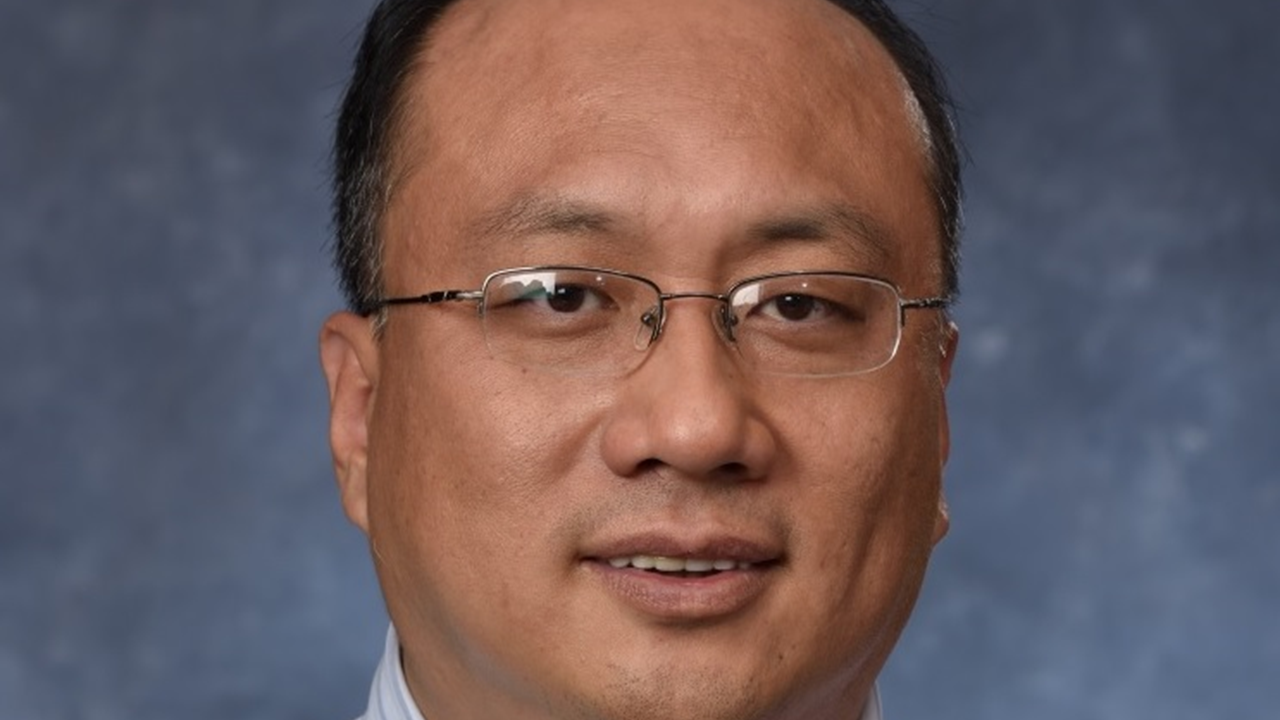
McKenna has been a research assistant at the UM-IHC for the past year, working with Abba Gumel, a Distinguished University Professor of Mathematics at the University of Maryland who has joint appointments in the UM-IHC and the Institute for Physical Science and Technology and holds the Michael and Eugenia Brin Endowed Chair in Mathematics.
McKenna, who graduated from South River High School in Edgewater, Maryland, began college at UC Berkeley this fall.
This interview has been edited for length and clarity.
What have you been working on at the UM-IHC?
I have been collaborating on a project using advanced mathematical tools to understand the behavior of measles during an outbreak. Specifically, we predicted how the disease would spread based on parameters like spread rate, vaccination rate and other factors. Our data came from a recent outbreak in Spartanburg County, South Carolina.
We applied the SVEIR compartmental model, with five differential equations, each representing individuals in one of five stages of measles (susceptible, vaccinated, exposed, infectious, and recovered). Estimating unknown values, we considered time spent at each phase and calculated both the mortality rate and recovery rate as individuals in our model moved through the stages. Ultimately, we altered different parameters to figure out which of the five phases was the most impactful on disease spread, at what stage the disease would die out, and so on. Among other findings, our data suggested that catch-up vaccination is the best way to control short-term outbreaks and increasing the proportion of newborns vaccinated is essential for long-term control.
How did you get involved with the UM-IHC?
I emailed Dr. Gumel during the winter of my junior year inquiring about getting research experience as a high school student. He then gave me a list of items to master before getting to the lab. Once I was in the lab, he gave extremely in-depth lessons on different topics that I could apply to my research project. When the project was complete, he suggested that my partner Ishaan Banerjee (now a senior at Montgomery Blair High School) and I present it at the Mid-Atlantic Research Exchange (MATRX) at Johns Hopkins University, an annual celebration of undergraduate research in mathematics. Dr. Gumel offered lots of constructive criticism as we prepared our talk and reviewed our paper to make it ready for publication. He was truly essential to our success from start to finish.
What do you hope to accomplish through your UM-IHC research?
We would like policymakers to learn how important real-world data is if they’re trying to implement a public health campaign. Our research backs up common messages like “get vaccinated” with quantifiable data, and people are less likely to ignore such messages when there is real information behind them. Indirectly, we hope to advance medicine more broadly by encouraging public health decision-makers to make supportive data available to the public whenever people must make a choice (e.g., to wear a mask, get a vaccine or otherwise adjust their behavior).
How has your experience at the UM-IHC prepared you for your next step?
My experience at the UM-IHC has impacted my future tremendously. Before coming here, I had taken the highest-level math class my school offered, but the IHC took me a step further, offering me a ton of experience with coding in MATLAB, which will help with my future classes.
While at the IHC, I also learned how to communicate professionally and precisely with people in higher education, especially during the presentation at MATRX. My time here also helped me understand what working in academia or on a Ph.D. is like, allowing me to see that it is something I’d enjoy doing and making it a viable option for my future. I am now inspired to conduct vigorous research in college using math to help advance other fields of science.