The University of Maryland Institute for Health Computing (UM-IHC) offers students at all levels opportunities to work with seasoned researchers and tap into the institute’s expertise and technologies.
For this Student Spotlight, we asked Lukas Herron what he learned and accomplished during his time working at the UM-IHC.
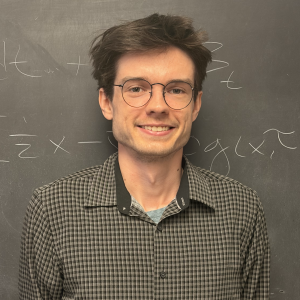
Herron is a biophysics Ph.D. student at the University of Maryland, College Park, who plans to graduate this summer. He is also the co-founder of Emergente, a startup focused on mapping the RNA structural landscape and designing better RNA molecules for therapeutics and drug discovery.
This interview has been edited for length and clarity.
What have you been working on at the UM-IHC?
I worked with [Professor of Chemistry and Biochemistry] Pratyush Tiwary to develop a computational model called RNAnneal that predicts the three-dimensional structures of RNA molecules. Biology relies on three kinds of information-carrying molecules: DNA, RNA and proteins. DNA stores genetic information in a double helix and proteins fold into intricate shapes to carry out many cell functions. RNA sits in the middle—carrying genetic information but also functioning by folding into complex shapes. Of the three, RNA is the least understood.
Protein structure prediction has advanced dramatically in recent years, largely because scientists have collected hundreds of thousands of experimentally determined protein structures forming a kind of “zoo” of known protein shapes that AI models can learn from. RNA is different. There are far fewer experimentally determined RNA structures (fewer than 2,000 non-redundant ones), which makes it much harder to train conventional AI models. My work focuses on developing RNA structure prediction methods that can still use the power of AI while working around this limited-data problem.
What UM-IHC tools and technologies have been helpful in your work?
One of the IHC’s greatest strengths is that it brings together a truly interdisciplinary group of researchers. That has been crucial for my work.
For example, through collaborations with the [Wei] Li Lab, we have been using our RNA structure modeling capabilities to study CRISPR—an RNA-protein nanomachine that can edit DNA. Interestingly, the three-dimensional structure of the RNA component by itself appears to help explain how efficiently CRISPR can edit the genome. This study is only possible if computational scientists, experimental biologists and domain experts work closely together.
More broadly, the IHC emphasizes translation, or applying basic scientific ideas to impactful problems in biology and medicine. RNA structure prediction sits right at the intersection of artificial intelligence, physics, chemistry, biology and human health, so the IHC has been a natural environment for this work.
The IHC’s Beacon supercomputer also represents an exciting new tool for this kind of research, and it will undoubtedly increase the speed and scale at which we can carry out RNA modeling and collaborate across the Institute.
What questions do you hope to answer through your UM-IHC research?
Most drugs today target proteins. But less than 2% of the human genome directly codes for proteins, while nearly 70% the genome is transcribed into RNA. Over the past few decades, we have learned that many of these RNAs aren’t “junk” but play important biological roles.
Two key questions we’d love to answer are: What are these RNAs doing? And how does their structure shape their function?
RNA structure prediction can help answer these questions, especially when RNA structures have proved challenging to measure in experiments. By predicting RNA folds that have never been seen experimentally, we may be able to expand the RNA structure “zoo” and better understand how these molecules regulate biology. That, in turn, could make it possible to target disease-causing RNAs more effectively, for example, with small-molecule drugs, gene therapies or engineered RNA-based systems.
Beyond disease, I believe RNA will become a programmable substrate for building biological circuits. In that sense, understanding RNA structure will not only help us explain biology that exists today but also design RNAs that carry out entirely new biological functions.
How has your experience at the UM-IHC prepared you for your next step?
I’m in a somewhat unique position because I’m one of the three co-founders of Emergente, a startup focused on designing better RNA molecules. My professional and scientific goals are closely aligned: I want to help build the tools that make RNA a truly engineerable class of molecules.
Working at the IHC has been invaluable for that goal. It has given me the opportunity to develop new computational methods while testing them on real biological problems with collaborators who have deep expertise in RNA, genome editing, disease biology and clinical translation. The diverse perspectives at the IHC help to ensure that the tools we build are not just technically interesting but useful for answering important biological and medical questions.